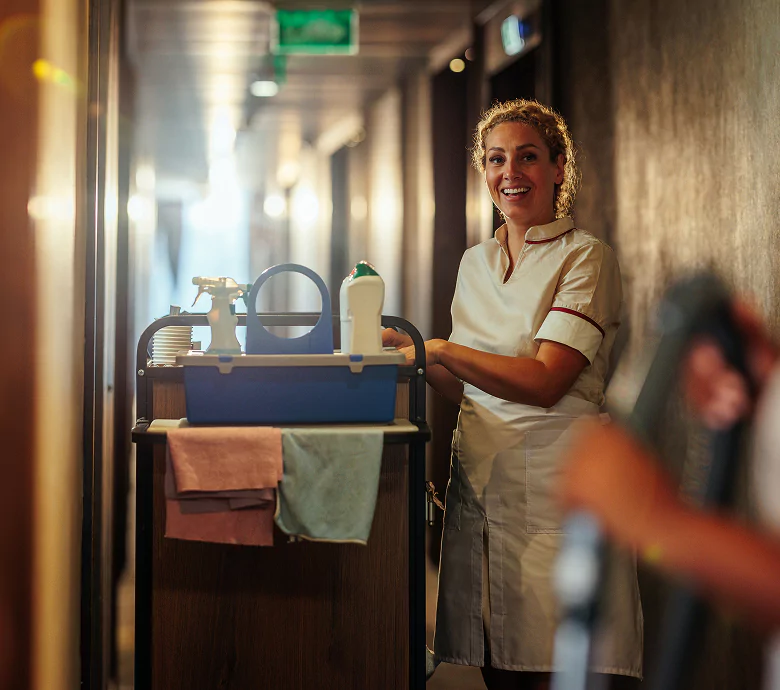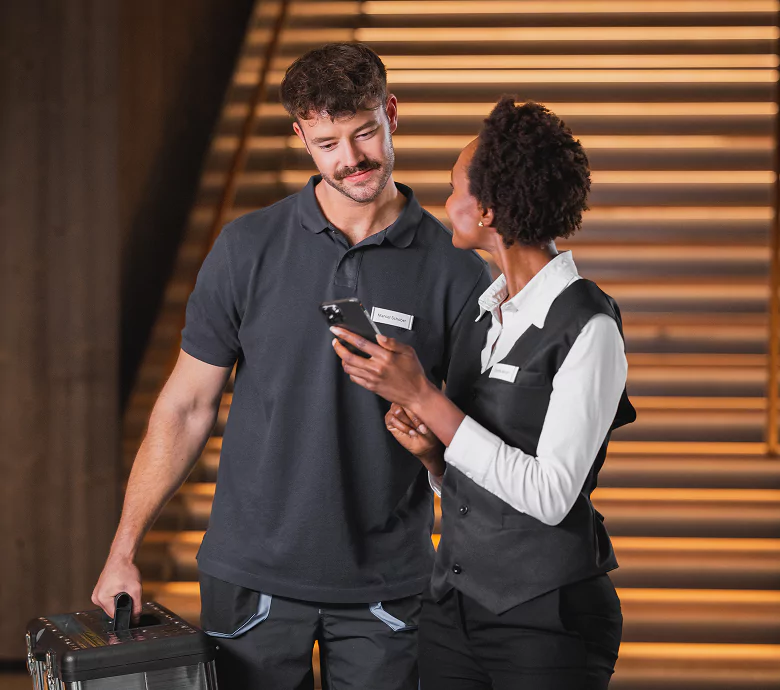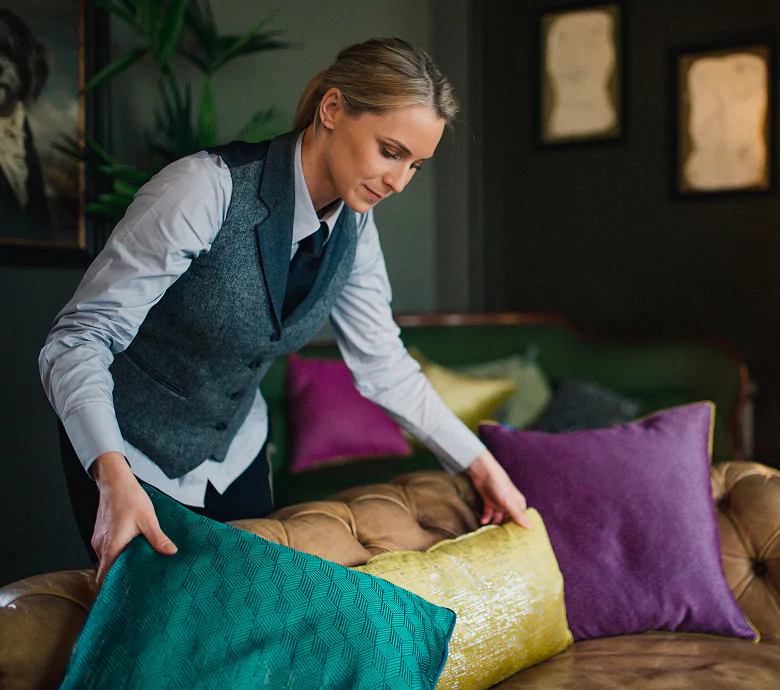
Hotel operations software is a type of hospitality software, usually cloud-based, that hotel teams use to manage their internal work in one place: communication between departments, tasks and checklists, shift handovers, repairs, housekeeping and knowledge. A property management system (PMS) handles guests, rooms and bookings; hotel operations software organizes the work of the team. The result is less information lost between shifts, faster processes, consistent standards and a clear view of what is still open.
The term is not used consistently, though. Some vendors apply it to their PMS, others to purchasing or analytics tools. Here, it means software that runs day-to-day hotel operations.
Hotel operations software vs. hotel management software vs. PMS
Hotel management software is the umbrella term for the hotel software that runs the business. It includes both the PMS and hotel operations software, and the two do different jobs:
| PMS | Hotel operations software |
| Manages guests, rooms and bookings | Organizes the work of the hotel team |
| Reservations, check-in, billing, room plan | Communication, tasks, checklists, handovers, repairs, knowledge |
| Used mainly by front desk and reservations | Used by all departments, including housekeeping and maintenance |
| Example: checking in a guest | Example: reporting a defect, fixing it and releasing the room |
Do I need hotel operations software if I have a PMS?
Yes, as soon as internal processes run across several departments and shifts. The PMS knows which guest is booked into the room and when the next arrival is due. It does not organize who fixes a loose shower holder in a departure room or make sure housekeeping hears that the job is done before the room goes back on sale. That is the work hotel operations software is built for, and the two systems can often be connected.
Why Teams or Slack fall short
General collaboration tools such as Microsoft Teams or Slack are built for office work. They handle chat well, but they lack the structures a hotel runs on: rooms, shifts, departments, checklists, repair reports and handovers. A broken minibar posted in a general channel has no room number field, no priority and no status. By the evening, it has scrolled out of view beneath the day’s other messages, and nobody can say whether maintenance ever saw it.
Why hotels are digitalizing their operations
Front desk, housekeeping, maintenance, F&B and management work around the clock, and every shift hands its unfinished business to the next. Many hotels still run this relay on paper lists, word of mouth and private messenger groups. That works while the team is small and stable. With staff shortages, high turnover or several properties, it starts to fray.
The makeup of hotel teams adds pressure. In 2022, 19 percent of workers in EU hotels, restaurants and catering were foreign nationals, more than twice the 8.7 percent across the economy as a whole, according to the European Labour Authority. Multilingual teams depend on clear, written information.
Where manual processes reach their limits
The weak spots are rarely dramatic. They are small gaps that add up:
- Handovers lose information. Whether a note reaches the next shift depends on someone finding the right piece of paper.
- Messenger groups hide responsibility. WhatsApp is fast, but messages sink in the chat history, nobody sees who is in charge, and private messengers for guest data are problematic under the GDPR.
- Knowledge sits in people’s heads. SOPs live in folders and inboxes, and experienced employees take their knowledge with them when they leave.
That is why hotel digitalization increasingly starts behind the scenes, where much of what guests experience is decided.
How hotel operations software works in daily hotel life
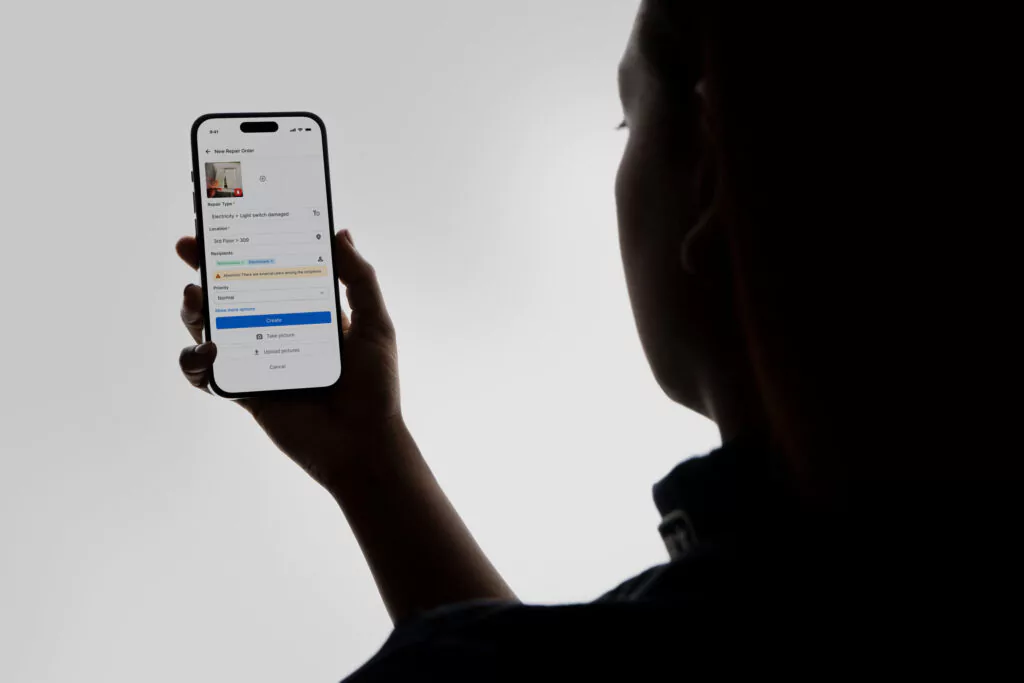
Take a city hotel. While cleaning a departure room, a room attendant notices that the shower holder has come loose. They report it in the app with a photo and the room number, and maintenance receives the task on their smartphones straight away. As long as the task is open, the room stays blocked in the housekeeping status, so the front desk can see that it is not ready for the guest arriving in an hour without calling to ask. Once the repair is done, maintenance closes the task and housekeeping releases the room.
The case stays documented. If the same holder works loose in three rooms on one floor, management spots the pattern in the analytics before a guest review does, and the fittings can be replaced in one go instead of one room at a time.
Core features of hotel operations software
The features below matter less individually than together: a repair report, a checklist and a handover note all refer to the same rooms, shifts and people.
Internal communication
Digital hotel communication replaces notice boards, word of mouth and messenger chats. Messages go to specific departments, roles or individuals, and read receipts show who has seen them. At AlpinTrend Group, which runs five hotels, eight restaurants and a chairlift, internal email dropped by 95 percent; what remains is correspondence with outside suppliers.
Tasks, checklists and handovers
Every task gets an owner, a deadline and a status, and recurring tasks are created automatically. The checklist for the evening round appears for the night shift every day at 10 p.m., and anything left unchecked stays visible. Digital handovers follow the same logic: open items from the late shift become tasks for the morning shift, each with someone responsible.
Repairs, maintenance and housekeeping
Anyone in the hotel can report a defect, on mobile and with a photo. Maintenance prioritizes, fixes and documents it, and maintenance intervals can be scheduled in advance. Room status, cleaning assignments and special requests run through the same platform, so the front desk and housekeeping see the same status without calling each other to check.
Knowledge management and analytics
Knowledge management in the hotel means that standards, SOPs, manuals and instructions are stored centrally and accessible to everyone, including a new hire on their phone in their first week. Analytics complete the picture with key figures such as open tasks, response times and recurring defects, across all properties if needed.
What are the benefits of hotel operations software?
The central benefit is transparency. At any moment, everyone involved can see which tasks are open and who is responsible, and most other benefits follow from that.
General managers, COOs and operations managers see all departments without a daily round of questions, keep standards consistent across properties and decide based on data rather than impressions.
Teams get clear responsibilities, fewer follow-up questions and faster onboarding, including the many employees who never sit at a computer. Guests notice the effect without ever seeing the software: requests are handled faster, wishes do not get lost and quality holds steady from the morning shift to the night shift.
KPIs that show success
Hotel process optimization is measurable. These key figures make a useful before-and-after comparison:
- Response time for repairs, from report to completed task
- Number of open tasks across departments
- Checklist completion rate as a measure of how consistently standards are applied
- Onboarding time until new employees work independently
- Guest reviews on service and cleanliness, where forgotten requests show up first
- Rooms blocked due to defects, measured in out-of-order days
What these figures can look like in practice: at the Steigenberger Hotel Herrenhof in Vienna, around 45 guest requests a day run through hotelkit, and 75 percent of them are completed within 30 minutes. The Mandala Hotel in Berlin saves around eight working hours a day in housekeeping, roughly one full shift, and each room attendant now cleans one more room per day on average. These are results from individual hotels, not averages, but they show which numbers are worth recording before a rollout.
What to look for when choosing hotel operations software
These questions help when comparing providers:
- Industry focus: Is the software built for hotels or adapted from another industry?
- Usability and mobile app: Can every department use it without long training, including housekeeping and maintenance on smartphones and tablets?
- Integrations: Can it connect to the PMS and other systems?
- Data protection: Is it GDPR compliant, and where are the servers located?
- Multilingual support: Can multilingual teams use it in their own languages?
- Scalability and rollout: Does it grow from one property to a hotel group, with guidance during implementation and a point of contact afterwards?
- Hotel group readiness: Can central standards be rolled out to all properties, with cross-property analytics and roles per property, department and level?
What is hotelkit?
hotelkit is hotel operations software that connects all departments of a hotel in one app, from the front desk to maintenance. More than 4,000 hotels in over 85 countries use it, from independent hotels to international hotel groups, and more than 180,000 employees work with it every day.
In practice, that mostly looks like ordinary shifts going right. At the end of a late shift, the front desk still has three open guest requests and a note about tomorrow’s group. The handover runs digitally, and the open items arrive at the morning shift as tasks, each with a name next to it.
Case study: Ruby Group
Ruby Group operates 21 hotels in 14 cities and uses hotelkit for consistent standards, digital handovers and repair management. 85 percent of repairs are completed on the same day, 54 percent within two hours.
“With hotelkit, we share our knowledge, define clear standards, and make them accessible to everyone, while maintaining the autonomy of each hotel.”
Nadja Andrei, Associate Director People & Culture Development, Ruby Group
Read the full story: How Ruby Group scales its hotel operations with hotelkit
Where to start: an honest look at your own hotel
Choosing hotel operations software does not have to begin with a vendor comparison. A more useful first step is one week of looking closely at your own property. Which channels do reports, handovers and follow-up questions travel through today? How many WhatsApp groups are there, and who is in all of them? How long does it take to fix a reported defect, and does anyone actually know? The answers show which of the features above your hotel really needs, and they give you the baseline that any rollout will later be measured against.ns software is built for mobile use. Housekeeping, maintenance and service use it on smartphones or tablets, for example to report a defect with a photo or tick off a checklist.